
Relationship between consciousness and mind from Adi Shankara’s work Drig-Drishya-Viveka (knowledge of knower and known) explained beautifully by Swami Tadatmananda. Verse 5-6
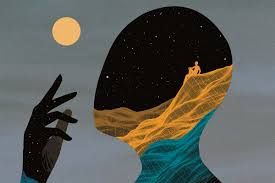
Apparently an individual don’t possess consciousness because it is omniscient (all knowing) and omnipresent (existing everywhere simultaneously) . Consciousness is like the sun that never rises or sets and present in the waking, dream and dreamless states of human existence. Consciousness does’t blink in-and-out of human existence, it precedes birth and succeeds death. Ancient rishis of Bharat (India) have realised this ultimate truth.
However a human mind has a relationship with the consciousness. Consciousness reveals the activities of the mind. As the mind perceives the external objects and internal objects through memory and experience, wave like form is created that is revealed by the consciousness. Just like how the ripples on a calm water obstructs the view of the reflected sun. So there is this relationship of knower and the known between the consciousness and mind.
There are two viewpoints to understand the relationship between consciousness and mind. One is pratibimba vada (reflection based) and another one is avacheda vada (limitation based).
Pratibimba Vada: This is reflection based understanding that says that our experience (pain, anger, jealousy, happiness, sadness, etc.,) is reflected consciousness (chit chaya). Every human experience is a vritti (fluctation) in the form of thought that disturbs the field of consciousness. So when there are vrittis in the mind, experience happens (good or bad). Example is sun reflecting clearly on the bucket of calm water. When ripples (vrittis) are formed on the water and the view of the sun is distorted.
Avacheda Vada: This is limitation based understanding that explains what vrittis (mental fluctations in form of thoughts) are. When we hold the image of an object in our mind, the form is the shape of the object itself that is un-real, limited and transient, but the underlying content is consciousness. Example is that of a wave that is form that does not have any existence of its own, and the substance is water which is the real existence. So vrittis are compared to wave and consciousness are compared to water. As you can see from the below table that the vrittis are limited inside a form that arises from the content of consciousness.
| Ocean | Individual | |
| Form | Waves | Vrittis |
| Content | Water | Consciousness |
When we synthesise both the above viewpoints, we come to a profound understanding that we are more than our mental activities (vrittis) . Our true nature is consciousness (Bhraman). When we calm the mental tides of thoughts and emotions, our true nature is revealed.
Here is the link to the discourse from Swami Tadatmananda. Verse 5-6

 fivelayers.net
Leave a comment